Content & Community System

User Story & UGC Content Asset System

Turning real user experiences into reusable trust-building content assets.

Overview Workflow Logic Results View Visuals

Case Overview

This case focused on turning scattered user feedback, reviews, and real brewing stories into a repeatable content-asset system. Instead of treating user stories as one-off posts, the goal was to organize them into a reusable trust-building content pipeline that could support blog storytelling, EDM segmentation, social engagement, and later reuse in broader brand and conversion assets.

Core Strategy

The core strategy was to transform real iGulu user experiences into a sustainable User Story & UGC Content Asset System. For a high-consideration DTC product like iGulu, brand-led explanation alone is not enough. Potential buyers need to see how real users brew, why they purchased, what they explored, and how the machine fits into everyday life. I therefore organized user stories into structured content assets: first collecting detailed user feedback and brewing context, then extracting persona tags, usage scenarios, product value, and story angles, and finally adapting them into blog content, EDM, Facebook / social posts, and reusable trust materials.
System Logic

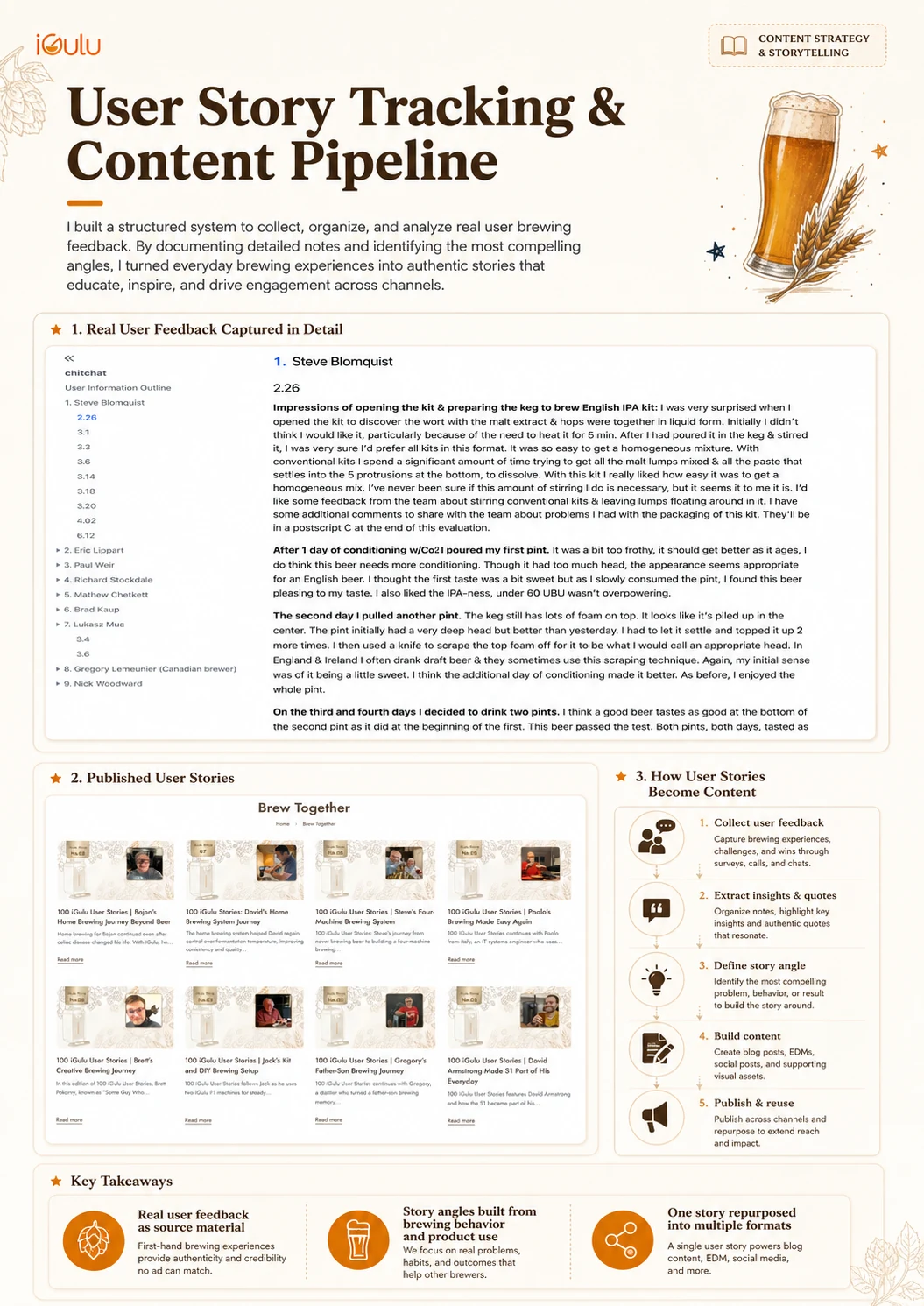
I built the process around a clear content flow: user record → story extraction → content production → multi-channel reuse → performance review. In practice, that meant documenting real user notes over time, identifying the most compelling angles, and then splitting one complete story into channel-specific versions. The blog carried full narrative depth, EDM handled segmented reach and trust building, Facebook post / social content supported community engagement, and UGC visuals could later be reused in product pages, CRM, ads, PR, or creator outreach.

Workflow Logic

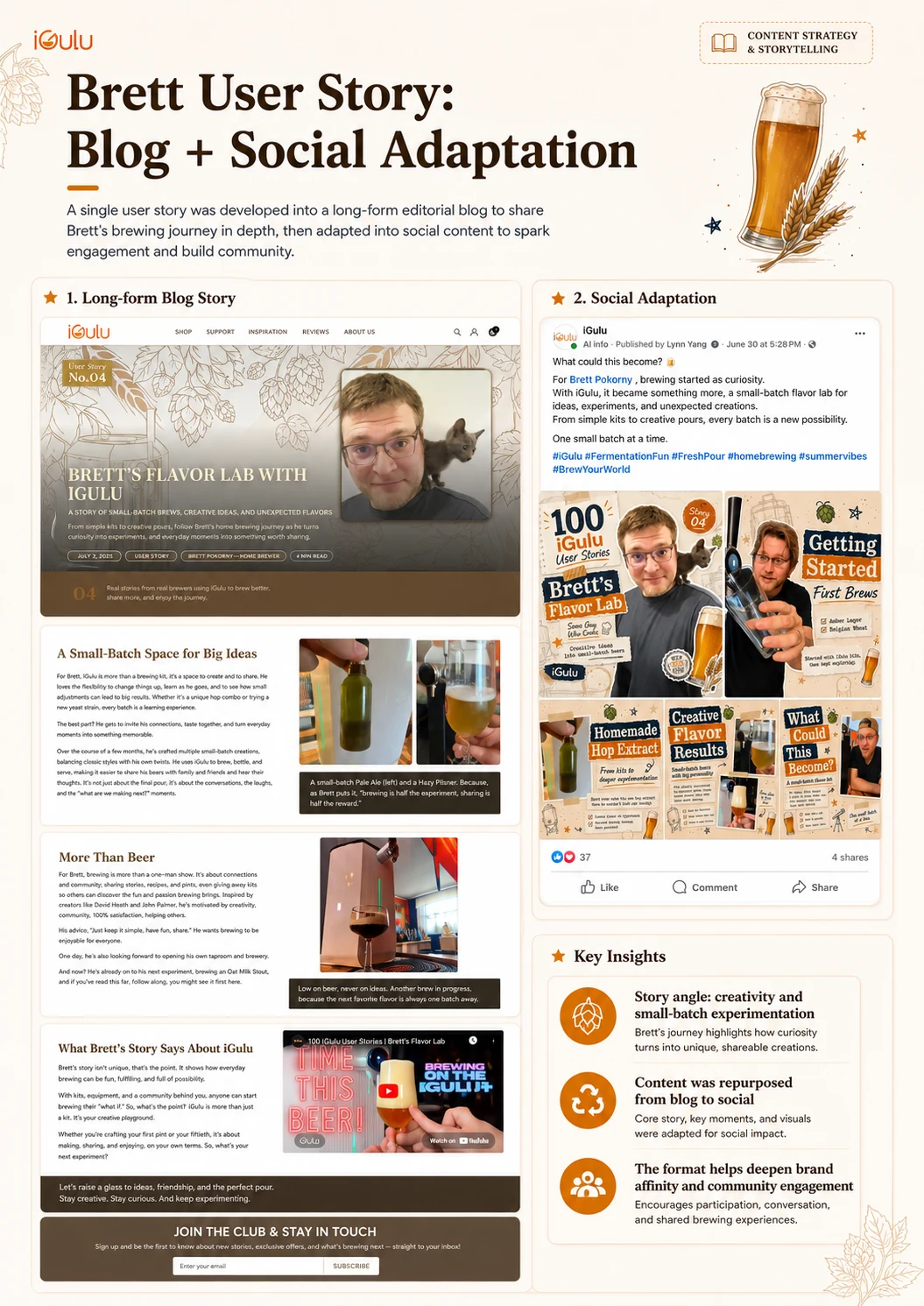
This system turned raw user feedback into repeatable brand assets by giving every user story a clear production path. Brett's case is a representative example: real brewing notes and visuals were developed into a full blog story, cut into an EDM asset, adapted for Facebook post / social content, and then retained as reusable trust content for future touchpoints.

1. Capture user recordCollect detailed notes, brewing feedback, quotes, photos, and user context through chats, surveys, or ongoing communication.
2. Extract story angleIdentify persona tag, brewing behavior, scenario, problem / curiosity, and product-value angle that make the story meaningful.
3. Build channel assetsDevelop long-form blog, segmented EDM, Facebook / social adaptation, and reusable UGC slices from one source story.

Results & Takeaways

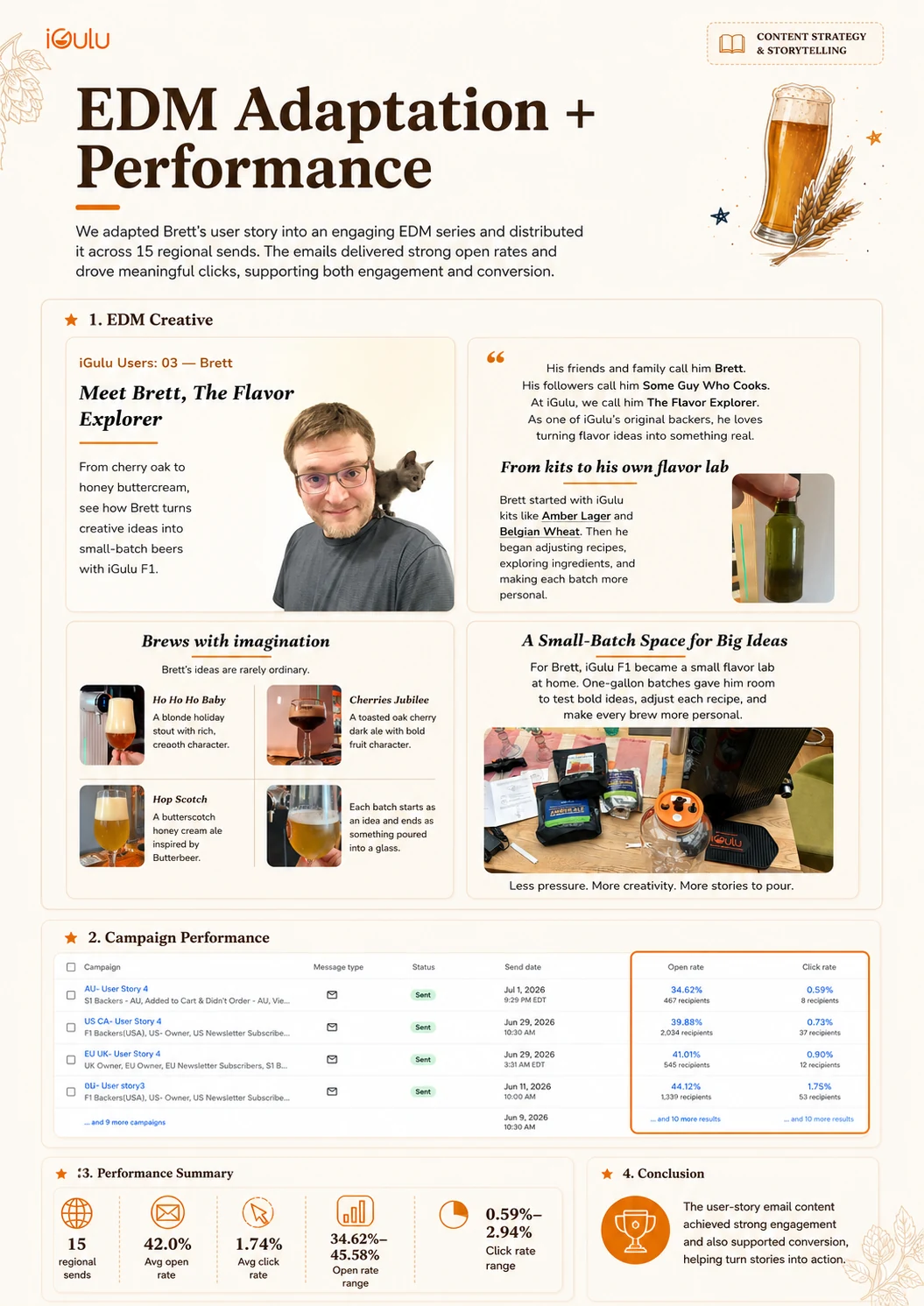
15User Story EDM sends across multiple regions and audience segments.
42.0%Average open rate, showing stable interest in trust-building story content.
1.74%Average click rate across story-based EDM sends.
34.62%–45.58%Open-rate range across User Story EDM campaigns.
0.59%–2.94%Click-rate range across regions and audience groups.

Through this system, user stories were no longer treated as one-time content. Instead, they became reusable brand-trust assets that could keep working across different touchpoints. Every story started from real user records, moved through structured angle extraction, and was then extended into blog, EDM, Facebook / social posts, and UGC visuals that could later support product pages, CRM, ads, PR, or creator outreach. Brett's story demonstrates this clearly: one real brewing journey became a full blog, an EDM content asset, and a Facebook post sequence that continued to build trust across multiple channels.

  • User stories supported trust-building and education better than pure promotional content.
  • One complete story could be repurposed into multiple assets instead of being consumed by a single post.
  • Cross-channel adaptation made content production more efficient while keeping the user voice authentic.
  • The system created a reusable content layer that could continue serving CRM, product, social, PR, and conversion needs.

Supporting Visuals

Image order follows the system workflow you requested: content pipeline first, then blog + social adaptation, and finally EDM adaptation and performance.

Previous System ← Product Ecosystem Expansion Back to Home Return to System Overview →