Creator Partnership Lifecycle & Content Seeding System
Keep long-cycle collaborations visible after the first “yes”
The bottleneck was not only finding creators. Manual sourcing consumed time, confirmed partnerships could stall across shipping and product-use cycles, and published content was difficult to evaluate consistently without scheduled review checkpoints.
Manual discovery was slow
Finding relevant creators across platforms, niches, and markets required repeated searching and first-pass evaluation. AI-assisted discovery reduced the repetitive part while human review remained responsible for fit and outreach decisions.
Confirmed did not mean completed
Shipping, brewing, tasting, content production, and publishing could span weeks. Without ownership, current-stage visibility, and next actions, confirmed opportunities could easily become inactive.
Publishing was not the end
Views, engagement, comment quality, reusable content value, and relationship potential needed to be reviewed after publication to guide reuse and repeat-collaboration decisions.
Connect every creator touchpoint in one operating model
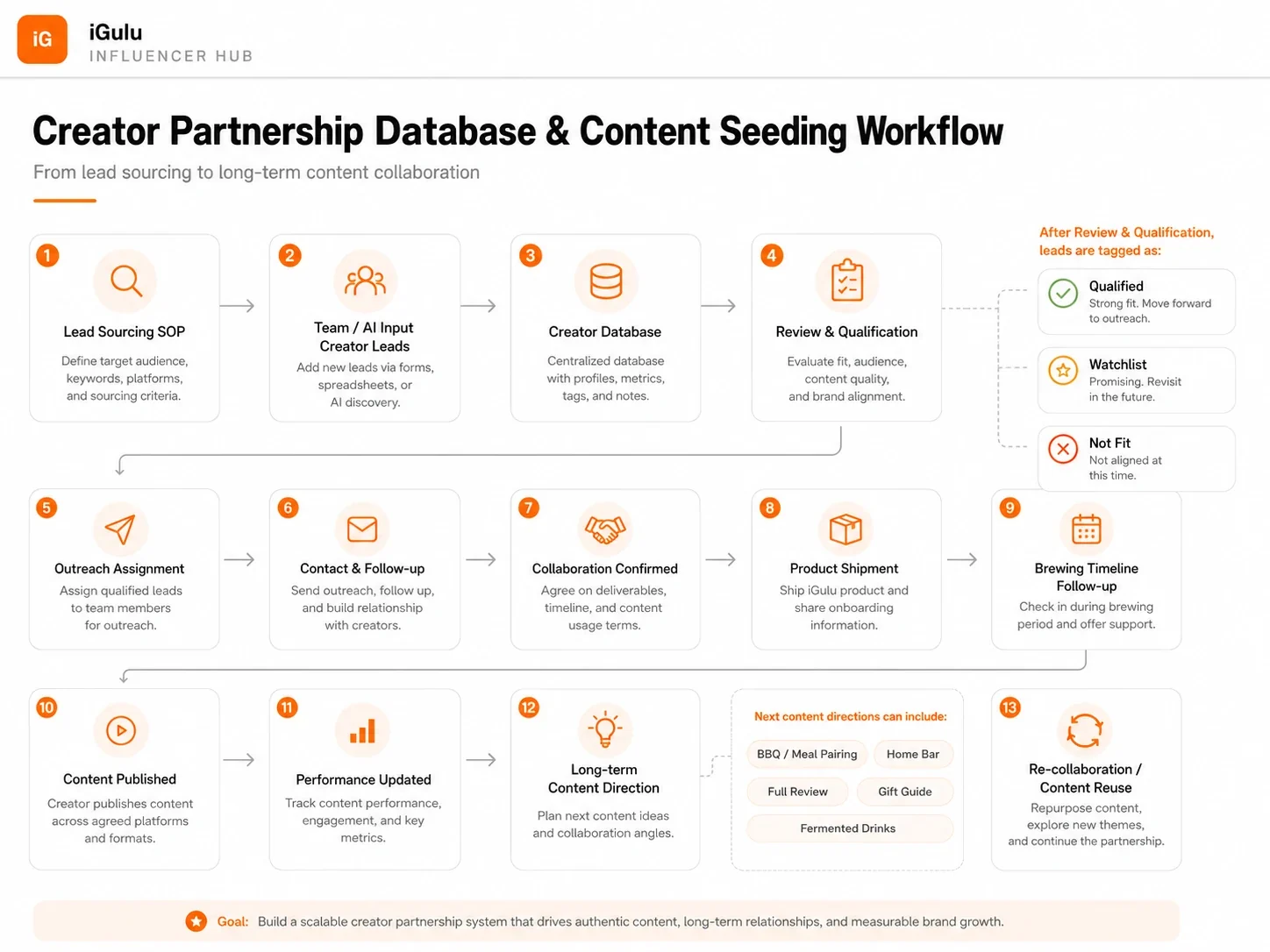
The original workflow remains the system overview, showing how team or AI-assisted sourcing feeds qualification, outreach, collaboration management, publication, performance updates, and re-collaboration.
Standardize who enters the pipeline
The qualification layer combines two kinds of guidance in one reference system: data-level sourcing and screening rules explain where to find creators and what basic signals to record, while content-fit analysis explains whether iGulu can enter the creator's actual content naturally, what angle is credible, what risks to control, and what deliverable is worth requesting.
How the reference system works
The slides stay in the same order, but the logic is easier to read when the data-level SOP and content-level judgment are explained side by side.
Sourcing, Screening & Content-Fit Reference
Use the arrows to review the data-level SOP, lead input method, and three content-level evaluation examples.
Manage leads, active collaborations, and published content as separate operating layers
The three-table structure keeps each stage focused: acquisition and outreach, collaboration execution, and content-performance management. The screenshots remain authentic operating evidence, presented in a consistent portfolio frame.
Extend collaboration management beyond the publish button
Published content enters a scheduled review layer so the team can evaluate both quantitative performance and qualitative signals before deciding whether to reuse the asset, deepen the relationship, or archive the collaboration.
Turn completed content into a reusable creator and content asset pool
Strong creators were retained based on content quality, delivery reliability, audience fit, reusable material value, and future collaboration potential—not only one-post reach.
Long-Term Creator Portfolio
Use the arrows to review selected long-term creator partnerships and the content value built across repeat collaborations.
What This System Established
A reusable creator partnership operating system connecting shared sourcing standards, AI-assisted discovery and first-pass analysis, visible collaboration ownership, stage-based follow-up, publication tracking, 7-day and 30-day review checkpoints, and repeat-partner development. It reduced collaboration loss across long delivery cycles and turned completed creator work into measurable relationship and content assets.