Turning Black Friday from a single discount event into a full-funnel campaign system.
Read Case →Growth System 01
Campaign System
This section shows how I turn key commercial moments and product launches into structured, repeatable campaign systems. Instead of treating campaigns as isolated executions, I design them around user stages, channel roles, conversion paths, and post-campaign learning.
Turning ingredient kit launches from one-off announcements into a repeatable launch system.
Read Case →Case 01 · Campaign System
BFCM 2025 Campaign
Turning Black Friday from a single discount event into a full-funnel campaign system.
Core Strategy
Early demand building + coordinated multi-channel conversion
The core strategy of this BFCM campaign was to build a complete full-funnel marketing system around early demand building and multi-channel conversion. Before Black Friday officially started, giveaway-led lead capture, early-bird registration, and EDM incentives were used to acquire potential users and convert external traffic into an owned audience pool.
Before the discount window opened, EDM, social media content, Facebook groups, influencer content, and PR were used to continuously educate users and build purchase intent. During the official BFCM period, the website, EDM, ads, community channels, and user advocacy were released in sync to drive concentrated conversion. After the main event, abandoned checkout recovery and comeback offers extended the conversion cycle and completed the growth loop.
System Design Logic
Design Black Friday as a structured system, not a single campaign execution
The core of this campaign was to deconstruct the marketing moment into a structured system. In the design process, I focused on three system-level questions:
- User stage: What awareness state is the user in — cold start, interest building, or purchase decision?
- Channel role: What should each channel do at each stage — acquisition, education, conversion, or recovery?
- Rhythm design: How can campaign timing reduce dependency on a single high-cost traffic source?
Based on this logic, the full Black Friday campaign was structured into pre-launch, launch, and post-launch phases. EDM, community, ads, content, influencer / PR, and user advocacy were coordinated as one connected campaign system.
Results & Takeaways
Upgraded Black Friday into one of the year’s most important revenue-driving nodes
This campaign successfully upgraded Black Friday from a single discount activity into a core revenue-driving marketing node, ultimately contributing approximately half of the year’s annual sales and becoming one of the most important growth sources of the year.
Audience expansionPre-launch demand building significantly increased the reachable user pool before the main sales window.
Concentrated conversionThe official launch phase drove strong sales growth through coordinated website, EDM, ad, social, influencer, and PR execution.
Recovery efficiencyAbandoned checkout recovery and comeback offers extended the conversion cycle after the main event.
System valueThe case proved that early acquisition, content education, multi-channel coordination, and CRM recovery can improve high-AOV DTC conversion during major commercial moments.
View BFCM Planning Framework
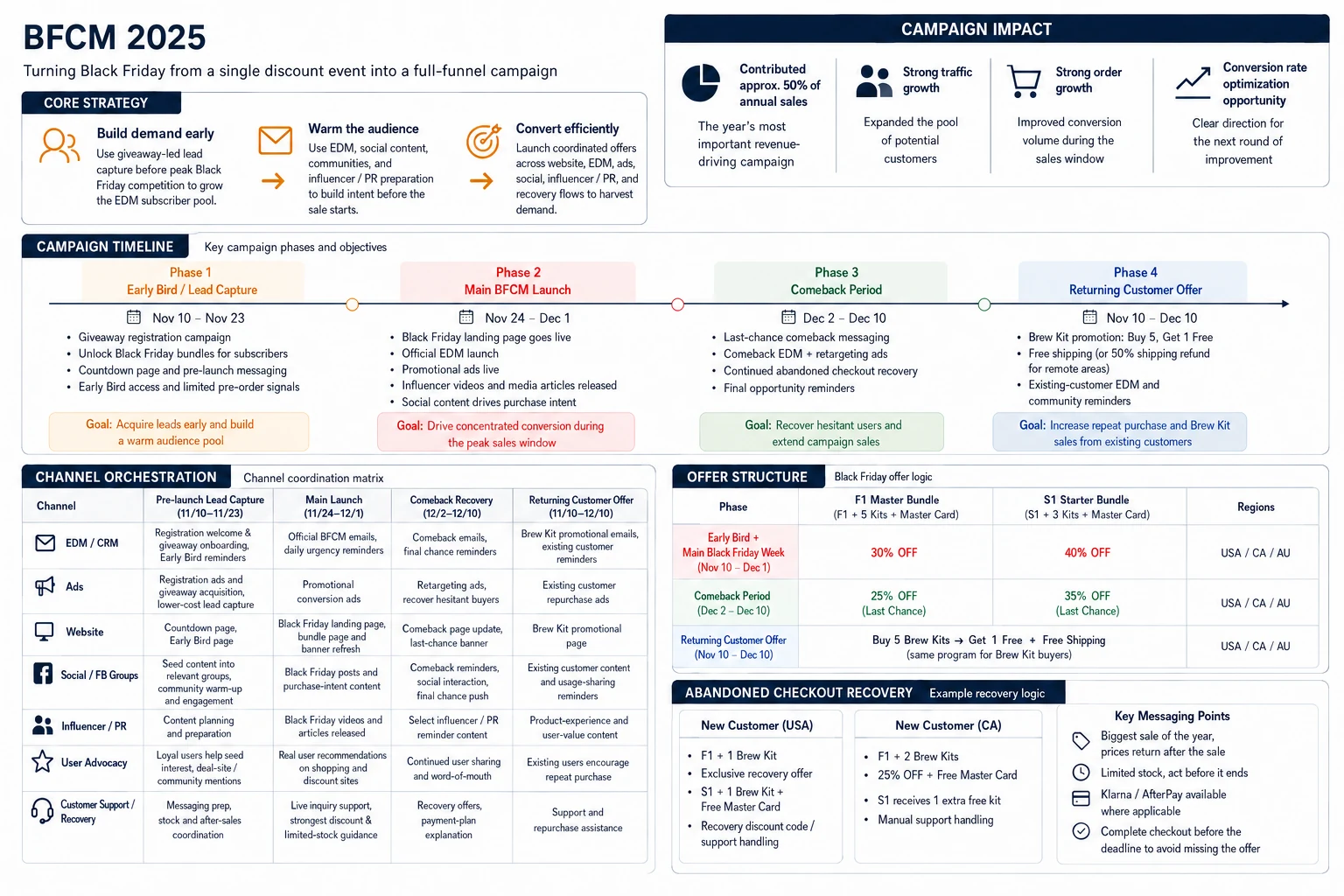
Campaign impact, timeline, channel orchestration, offer structure, and abandoned checkout recovery logic.
Case 02 · Campaign System
Ingredient Kit Launch Workflow
Turning ingredient kit launches from one-off product announcements into a repeatable launch system.
Core Strategy
Build a reusable launch workflow for every new kit release
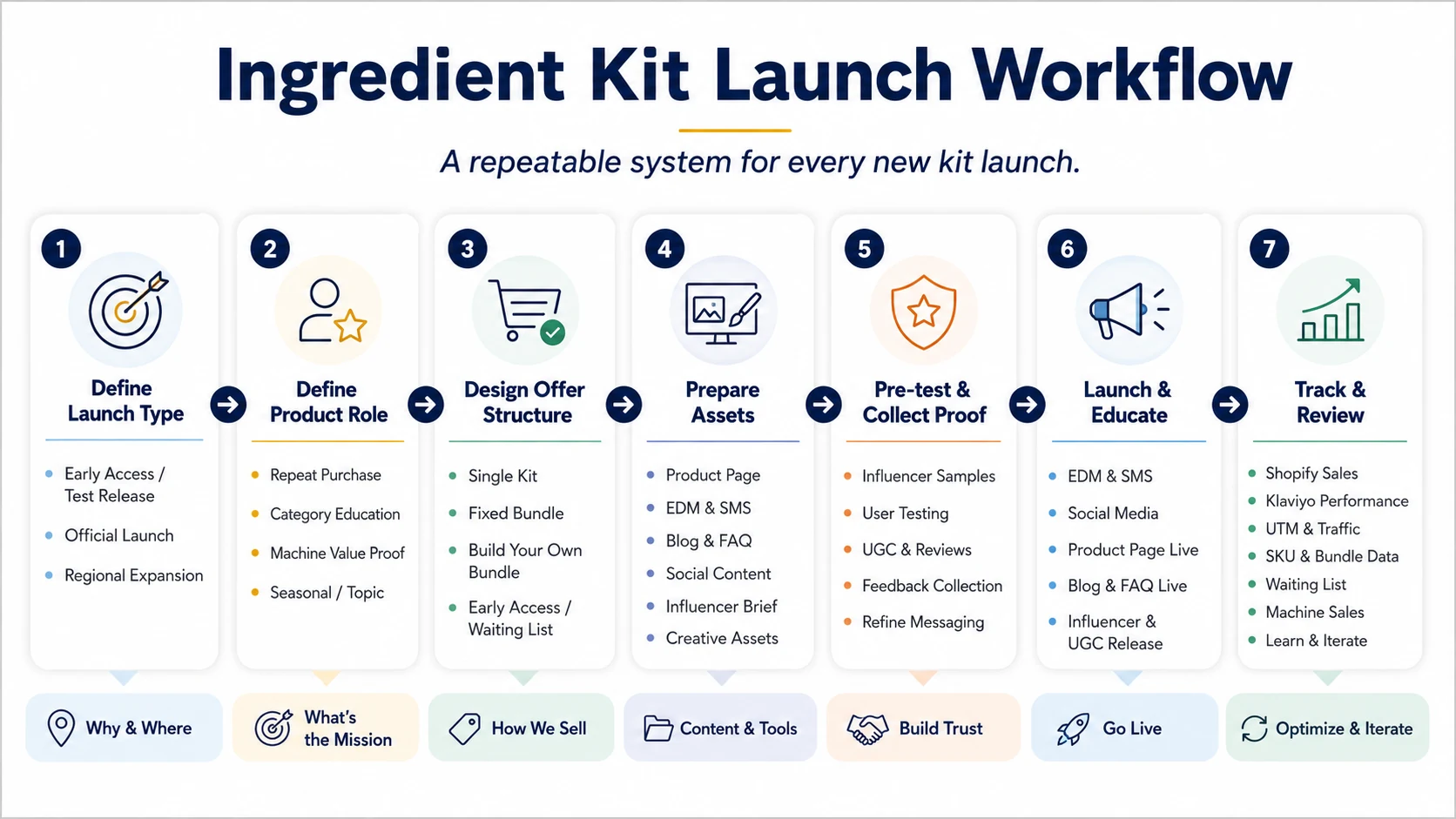
The core strategy of this case was to turn iGulu’s ingredient kit launches from a single-point execution — product listing plus EDM announcement — into a reusable launch workflow. Before each new kit or bundle release, the first step was to identify whether the launch was an early access test, an official launch, or a regional expansion.
Then, the kit’s business role was defined: whether it served repeat purchase, category education, machine value proof, or seasonal/topic-driven demand. Based on the launch objective, the sales offer, content assets, product page structure, social media rhythm, influencer or user testing, official release plan, and post-launch review process were designed accordingly. This made each kit launch business-objective driven rather than simply a new product announcement.
System Design Logic
Different ingredient kits need different launch messages and conversion paths
The core logic of this launch system is that not every ingredient kit should use the same launch message or conversion route. In the design process, I focused on three questions:
- Product role: Is this kit driving repeat purchase, category education, machine value proof, or a seasonal topic?
- User barrier: Is the user unfamiliar with the category, the flavor, or the purchase value?
- Conversion format: Should the launch use single-kit sales, fixed bundles, build-your-own bundles, early access, or a waiting list?
Based on these judgments, the ingredient kit launch process was broken down into a full workflow: launch type definition, product role definition, offer structure, product page, EDM, SMS, blog, FAQ, social content, influencer testing, user feedback, and data review.
Results & Takeaways
From one-off launch execution to a reusable launch method
Through this workflow, ingredient kit launches were no longer treated as isolated product releases. Instead, they gradually became a reusable launch method that could be adapted to different business goals.
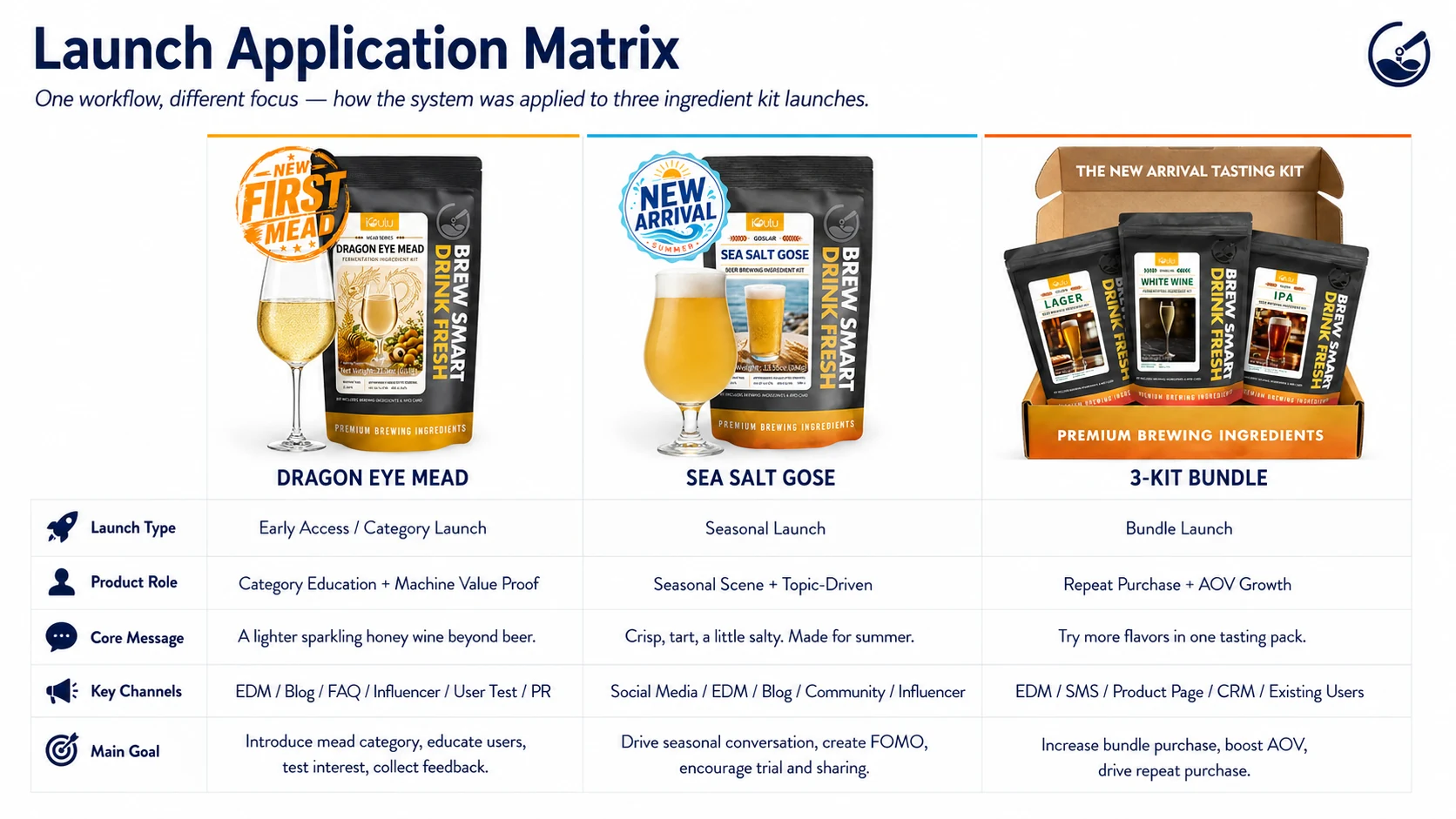
Across Mead, Sea Salt Gose, and the 3-Kit Bundle, the same workflow was applied with different focuses: Mead emphasized category education and machine value proof; Sea Salt Gose focused on seasonal context and social conversation; the 3-Kit Bundle focused on repeat purchase and bundle buying.
For a “machine + consumables” product like iGulu, ingredient kit launches are not just about selling a new flavor. They continuously educate users, activate existing customers, prove the machine’s value, and drive repeat purchase. An effective ingredient kit launch should work as a complete growth process: define product role first, then design the sales path; reduce user cognition barriers first, then use content, community, and CRM to complete conversion; finally, review data to improve the next launch.
View Launch Workflow Visuals